


The summer Sofia Coppola shot The Virgin Suicides (1999), part of the financing pulled out just before shooting began. The producers were always worried that the production would shoot too much and run out of film. Even so, whenever a scene had the girls lounging around their room, Coppola kept the camera rolling. She looked back on that summer in a 2018 interview with the American film site The Playlist. The Virgin Suicides was her first feature film, shot over a single summer in Toronto, Canada.
The film is set in a quiet American suburb in the 1970s. The neighborhood boys admire the five Lisbon sisters from a distance. After Cecilia, the youngest, dies suddenly, the sisters are shut away inside the house more and more. The story unfolds as the boys who watched the sisters back then look back as grown men. It is based on Jeffrey Eugenides's 1993 novel of the same name.
In Korea, a 4K remaster of the film opened at Cinecube Gwanghwamun on November 11. The same day, Lotte Cinema rereleased Marie Antoinette (2006), again starring Kirsten Dunst, for its 20th anniversary. Screening details are at the end of this piece. Here we look at the 35mm film both movies were shot on, along with two photobooks that came out this year. Both were published by Important Flowers, the imprint Coppola set up with the British publisher MACK.
Blue for the Girls' Room
In a 2016 interview with the same outlet, the cinematographer Edward Lachman said the film was shot as two separate worlds. The world of the girls, shut inside the house, was tinted magenta and blue. The world of the boys outside was shot in plain sunlight and stronger colors. For the film stock, Lachman chose Kodak 5277. It had originally been made for television and had lower contrast than other stocks of the time, so the colors came out muted. The stock had already been discontinued, and Lachman had to track down whatever was left.

The 4K edition from the Criterion Collection, the American film label, was made from a scan of the original 35mm camera negative. Coppola approved it, and Lachman supervised. The aspect ratio is 1.66:1. The credits compiled by Criterion list four still photographers, and one of them is the director, Sofia Coppola.
In the same Playlist interview, Coppola said the novel was written from the boys' point of view, and the film tried to keep that distance. What drew Coppola in, though, was the girls: their inner world and their air of mystery, and the boys who had no idea what to make of them. The soft colors on screen and the production design grew out of that.

Downtime at Versailles
Marie Antoinette was shot at the Palace of Versailles in France in the spring of 2005. Coppola obtained a rarely granted permit to film inside the palace and shot even in the queen's bedchamber. The American magazine W has described the film as a portrait of the doomed queen as a teenage girl. The lead, once again, is Kirsten Dunst. Dunst was a teenager when cast in The Virgin Suicides and turned 23 during the shoot at Versailles.

The cinematographer was Lance Acord. For the 20th anniversary, a new 4K restoration has also come out. Sony Pictures made it with the production company American Zoetrope from a scan of the original 35mm negative, and Acord and Coppola checked the color. The Paris Theater in New York screened the restoration this past September.
There was one more photographer on this set: Andrew Durham, a friend of Coppola's since the early 1990s. Durham was working as a television studio executive and quit that job on the very day Coppola called with an invitation to Paris to photograph the film. Durham showed up with a small Contax 35mm camera and followed the production from the first day of shooting at Versailles to the premiere at the Cannes Film Festival.

In an interview with W, Durham said there is a lot of waiting around on a film set. While the camera was being set up and while the actors rehearsed, there was plenty of time to wander and take pictures. Durham photographed Dunst and Jason Schwartzman sprawled out and resting in their towering wigs. Durham also photographed extras in full period costume talking on cell phones or smoking, and the lavish interiors of the palace.

Durham had meant to keep the pictures private. But Carine Roitfeld visited the set and asked to see them, and they ran as a story in Vogue Paris before the film opened. Making Marie Antoinette (Important Flowers / MACK, 2026), out this year, is a 176-page book of those photographs. It includes a few that even Coppola had never seen. The book also carries a conversation between Durham and Coppola and an oral history compiled by Keaton Bell. The voices in the oral history are Dunst, Schwartzman, Rose Byrne, Molly Shannon, Jamie Dornan and Marianne Faithfull.
In the book, Coppola writes about a recent break-in at the director's own building. The thief took only one thing: a single photograph Durham had taken on Marie Antoinette. Passing the story along, Durham joked, “Was the robber a teenage girl?”

For the 20th anniversary, the Palace of Versailles is holding an exhibition on the film at the Petit Trianon through January 24, 2027. Put together with Coppola, it shows early mood boards, costumes and pieces of the sets. The palace's press materials also include Durham's on-set photographs of Coppola and Dunst.
The Art Teacher at Malverne High School
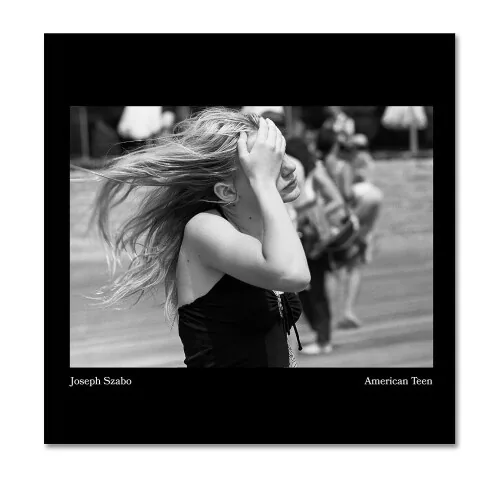
The other book is American Teen (Important Flowers / MACK, 2026) by the photographer Joseph Szabo. Szabo joined Malverne High School on Long Island, New York, as an art teacher in 1972 and taught there until retiring in 1999. Szabo started a photography club and a darkroom at the school and taught students how to take pictures and make prints.
In an interview with the British magazine Huck, Szabo said the students who had no interest in school were hard going at first. So Szabo began bringing a camera into the classroom as a way to get closer to them. In 1978 came the photobook Almost Grown, which paired the pictures with poems written by teenagers. The photographer Cornell Capa wrote the foreword.

Coppola first came across Szabo through a single album cover. From September last year to March this year, the Victoria and Albert Museum (V&A) in London held Sofia Coppola's Photography Bookshelf, a display where visitors could page through photobooks Coppola had picked. In a piece the V&A published for the display, Coppola recalls first learning of Szabo from a picture of a young girl smoking on an album cover for the rock band Dinosaur Jr. Coppola owns a print of that photograph, too. Szabo's books Teenage and Almost Grown came from Arcana, a bookstore in Los Angeles that Coppola often visited in the '90s. Szabo's pictures, Coppola says, hold the feeling of being a teenager in the '70s, and Szabo has a real knack for catching a moment.
American Teen is a 240-page book of photographs Szabo took of students in the 1970s and '80s. It gathers pictures that had been spread across several earlier books and adds some published here for the first time. Coppola commissioned the book and wrote its foreword, and Kim Gordon of Sonic Youth contributed a text as well. In the foreword, Coppola writes of loving the kids in these photographs. They don't pose. They are so used to Szabo and the camera that they simply stay as they are, at ease in front of it. Looking at the pictures, Coppola writes, you feel as if you have slipped in among the kids and are peering into their world with them.

When Nothing Happens
The three works were made by different people at different times. One is a feature film, and the other two are photobooks. Yet the camera lingers in similar places: the stretches between events, when nothing happens. With producers fretting about running out of film, Coppola filmed the girls sprawled around their room at length. Durham pressed the shutter while waiting on camera setups and rehearsals. Szabo's students blow bubbles over their tests and spend the night with the car doors open.
What Coppola saw in Szabo's pictures, too, was kids at ease in front of the camera. If you see The Virgin Suicides in a theater, it's worth noticing how long the scenes of the five sisters lounging in their room go on. That is where the film the producers feared would run short ended up. In those long scenes, how at ease were the girls in front of the camera?
Details
- Korean release The Virgin Suicides (1999), 4K remaster, Wednesday, November 11, 2026, exclusively at Cinecube Gwanghwamun in Korea. 97 minutes, rated 15 and over in Korea. Imported and distributed by Andamiro Films
- Korean rerelease Marie Antoinette (2006), 20th anniversary, Wednesday, November 11, 2026, exclusively at Lotte Cinema in Korea. 122 minutes, rated 15 and over in Korea. Imported and distributed by Lotte Cultureworks / Lotte Cinema
- Photobook Andrew Durham, Making Marie Antoinette (Important Flowers / MACK, 2026), 176 pages. Sold in Korea by Aladin for 101,200 won (Aladin price as of November 4)
- Photobook Joseph Szabo, American Teen (Important Flowers / MACK, 2026), 240 pages, texts by Sofia Coppola and Kim Gordon. Sold in Korea by Aladin for 101,470 won (Aladin price as of November 4)


