Nancy Rexroth's first retrospective, 《Secrets of My Power》, opens October 2 at the Cincinnati Art Museum. It brings together more than 150 objects: photographs, personal belongings, working tools and records. Most have rarely been shown, and some are on view for the first time. The museum is using the show to mark the 50th anniversary of her work 《IOWA》.
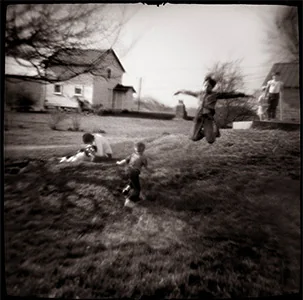
《IOWA》 is a book of photographs made with a Diana camera. Plastic body, single plastic lens, sold as a toy. The pictures are blurry and the corners go dark. For years the book has been introduced as a kind of starting point for toy camera photography. Read what Rexroth said and what she left in her working records, though, and the story changes. The blur was not something the camera handed her.
A toy in a graduate student's hands
Rexroth was born in 1946 and grew up in Arlington, Virginia. In 1969, as a graduate student at Ohio University, she first picked up a Diana that an instructor had bought in New York's Chinatown. The Diana was made in the 1960s at a plastics factory in Hong Kong. It shoots squares about 4 centimeters on a side on 120 roll film. The shutter has two settings, instant and bulb, and even within the same model, focus and light leaks varied from one camera to the next.
Did Rexroth welcome the camera's flaws? In a 2011 interview with photographer Blake Andrews, she said she did not care for the light leaks, the inaccurate viewfinder or the parallax. It bothered her that she could not see exactly what was being recorded, the way she could with the Nikon SLR she had used before, and composition still mattered. What she held on to was what could be done with that camera. "It was not the camera but what could be done with it."
An Iowa shot in Ohio
From 1970 to 1976, Rexroth traveled around the small towns of southeastern Ohio. She photographed houses and children, families and trees. A few pictures taken in Kentucky are mixed in. Despite the title 《IOWA》, most of the photographs came from Ohio.
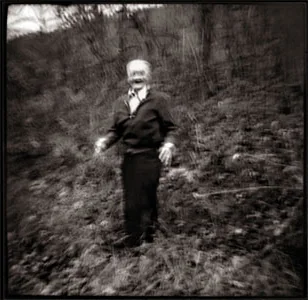
The title came from childhood summers. She used to spend summers in Iowa visiting relatives. That memory surfaced only later. After about five years of shooting, she needed a name for the work to write a grant application to the National Endowment for the Arts (NEA), and only then, she has said, did she realize that what tied the pictures together was the Iowa of her childhood. Her explanation fits in one sentence: "Iowa was a state of mind." It was less a place than a mood.
Even the blur had a standard
She had several ways of making a blurred picture. She moved her body while holding the camera so the image smeared. She also pressed the bulb shutter two or three times in quick succession, stacking slightly offset exposures in one frame. 〈Waving House〉, shot in Vanceburg, Kentucky, in 1975, was made that way. The house seems to overlap itself, as if waving.
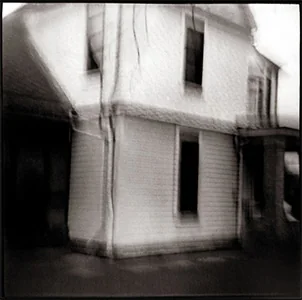
That did not mean she used every blurred frame. Rexroth chose a negative only when the blur worked on several levels at once, so that she came to believe reality really did look that way. She called this standard "The Integrity of the Blur." Being blurred was not enough. The picture had to hold together while blurred.
How far can you enlarge a blurred picture shot on small film? Rexroth's answer was to print small. Her prints were usually squares about 4 inches on a side, and if the forms could not hold up at that size, she went smaller. She sometimes spent ten to twelve hours on a single black-and-white print. For the interiors in the third part of 《IOWA》, she added gold toning on top of sulfide toning, giving them a soft, pinkish sheen. It is hard to call pictures that went through all this the camera's magic.


The 1977 first edition and the 2017 revised edition
《IOWA》 was self-published in 1977 through Violet Press, which Rexroth founded. It ran about 70 pictures, one per page, at roughly 4 inches. Forty years later, in 2017, the University of Texas Press released a 168-page hardcover revised edition. According to the publisher, it added 22 previously unpublished photographs. Alec Soth wrote the foreword and Anne Wilkes Tucker wrote the essay.
Rexroth beyond the Diana
The thing to watch in this retrospective is the archive. The Cincinnati Art Museum began organizing the work with the artist in 2017 and completed its acquisition of the archive in 2021. The vintage prints alone number more than 400. They include nearly all the Diana images from the 1977 and 2017 editions of 《IOWA》, along with experiments that were never shown.

Alongside the Diana work are platinum prints, Polaroid SX-70 transfers, gum bichromate prints and cyanotypes, unmounted film positives and a 53-slide slide show. There are also pictures shot in the early 2000s on a low-resolution consumer digital camera. The artist's papers and tools, and the anonymous snapshots she collected, are grouped separately. The museum's inventory alone makes "toy camera photographer" too narrow a label for Rexroth.

A scholarly catalogue accompanies the exhibition. Edited by curator Nathaniel M. Stein, it runs 224 pages with 164 plates. It is due out October 13.
《IOWA》 again, in the age of filters
Today you can blur a photo and add light leaks with a single button. In Korea, Lomography's Diana F+ is sold alongside 120 film. But what Rexroth used was the original 1960s Diana, a different product from today's Diana F+.
How is loving film's failures and accidents different from taming those accidents into your own language? 《IOWA》 shows the difference. Rexroth set a standard for choosing which blurred frames to keep, and spent half a day on one small print. Look long enough inside the smeared areas of the pictures above and you can see how the blur is built.
Exhibition information
- Exhibition Nancy Rexroth: Secrets of My Power
- Dates October 2, 2026 to January 3, 2027
- Venue Cincinnati Art Museum, Cincinnati, Ohio, USA
- Admission Free
- Member preview October 1, 5 to 8 p.m. Open to the public from October 2.
- Catalogue 《Nancy Rexroth: Secrets of My Power》, Giles · Cincinnati Art Museum, 224 pages, due out October 13, 2026
The exhibition description and official images are on the Cincinnati Art Museum exhibition page, and the archive is laid out on The Nancy Rexroth Collection page. The show is also one of the main exhibitions of the 2026 FotoFocus Biennial, held across the Cincinnati area in October.