

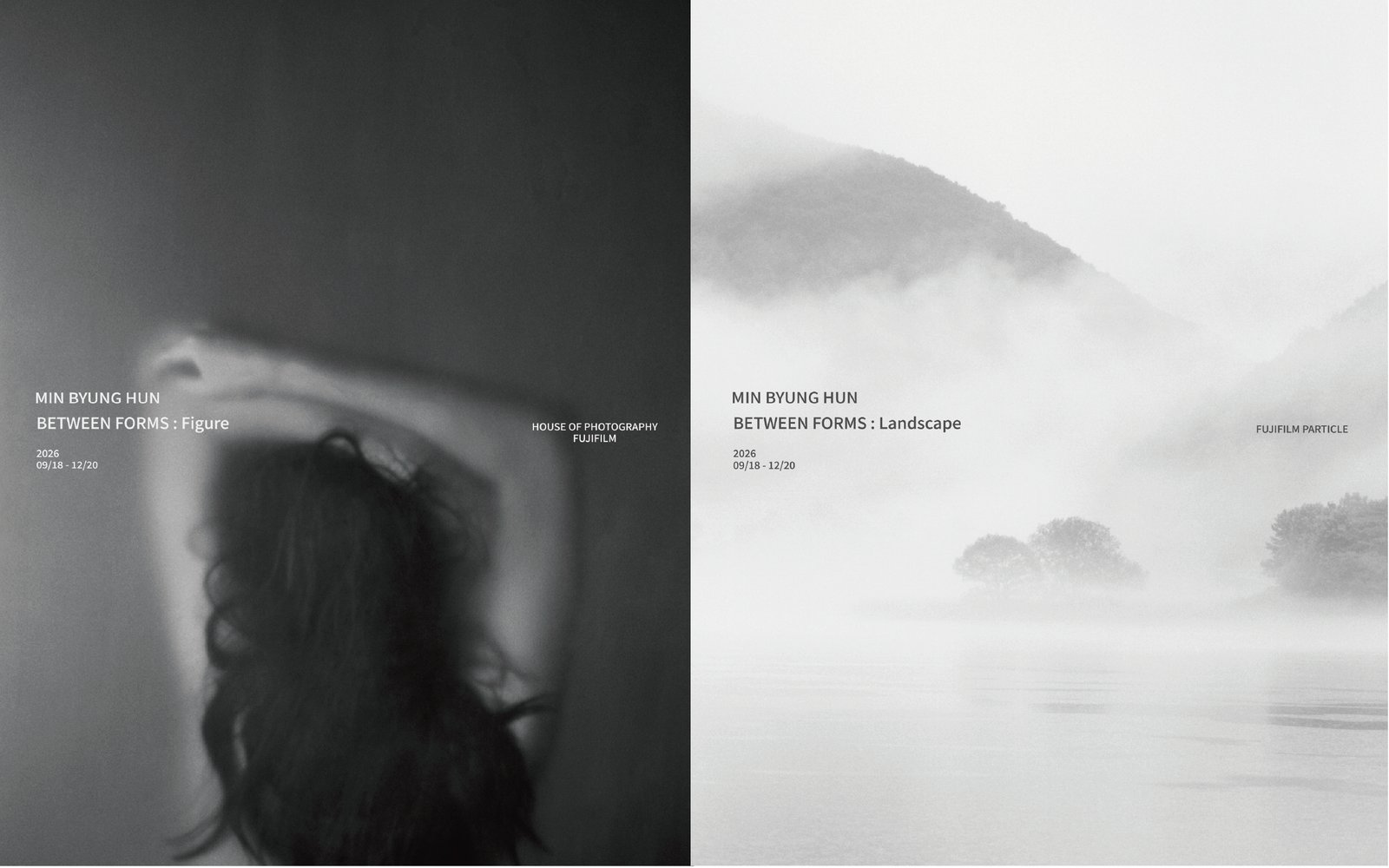
Min Byung-hun picks overcast days to shoot. He has done everything himself, from shooting on film to making gelatin silver prints. His solo exhibition 〈BETWEEN FORMS〉 is on view at two venues in Seoul from September 18 to December 20. The landscapes hang at FUJIFILM PARTICLE in Gangnam, the figures at HOUSE OF PHOTOGRAPHY in Itaewon. Fujifilm Korea runs both spaces, and this is the first time a single exhibition has been split between them.
The exhibition text uses the word gray again and again. It turns up in the introduction to the landscapes and in the introduction to the figures. The text also says where that gray is made. The artist does the printing in the darkroom, it notes, and for Min, printing is the work of adjusting a photograph's density and texture in fine detail.
Black and white, contrast turned down
Min Byung-hun has made black-and-white straight photographs for more than 40 years, since the mid-1980s. Straight photography means shooting what is in front of the camera as it is, without staging or altering the scene. Born in 1955, Min is self-taught and never studied photography formally. In a 2024 interview with Design+, the artist looked back on the mood of the amateur years. The contrast between black and white had to be strong, no matter what, and people said good pictures only came on bright, sunny days. At first Min followed those rules. But as Min kept doing the post-shoot work by hand, a question took shape: "Why does a photograph have to be high in contrast just because it's black and white?"
Min picks shooting days to match. In a 2020 interview with the Seoul Shinmun, the artist said that for a hazy photograph, the most important thing is to shoot in overcast weather. Making the gray begins before the shutter is pressed, with the choice of weather.
Nothing handed off in the darkroom
The talk of film and photographic paper comes from Min's interviews.
According to the Design+ interview, Min Byung-hun hands off no part of the process, from shooting to printing. The prints are analog gelatin silver prints and nothing else, and the image as first shot is never manipulated or retouched. A 2025 article in Gyeongbuk Maeil likewise reported that Min does every step personally, from shooting on film to printing in gelatin silver, and makes an edition of only a few prints of each work. The soft gray tones of these prints have earned a name of their own: "Min Byung-hun Gray" (민병헌 그레이).
So why do the printing yourself? Most people take their film to a lab, but Min printed at home from the very start. The Design+ interview gives an example. Take film shot in thick fog to a lab, the artist said, and the lab will correct it so the picture doesn't come out hazy. Print it yourself, and you can feel your way back to that day's landscape and what you felt then, and print closer to the actual scene. That, Min said, is how the photographs kept getting hazier. Even now, Min keeps printing in the darkroom until an image comes out that matches what was felt that day.
The darkroom also explains why Min shoots only black and white. At first the artist shot both color and black and white. Printing at home, though, color turned out to be far more demanding technically, and the chemicals cost more. So Min gave up color. Min also gave another reason: the first photographs that drew Min in were black-and-white ones, seen in a friend's home darkroom in high school. Once the printing is done, Min does the spotting too. Fine dust on the film leaves white dots on the paper no matter how carefully you clean it, and spotting means filling those dots in one by one with a brush dipped in paint.
Since 2016, Min's studio has been in Gunsan, Jeonbuk. It is an old Japanese-style house more than 100 years old, renovated to serve as both home and workplace. In the studio photos Design+ published, boxes of photographic paper are stacked layer upon layer.
PARTICLE: fog and water

〈BETWEEN FORMS: LANDSCAPE〉, on PARTICLE's basement level, brings together landscapes of fog and water, trees and forests. The exhibition text introduces these subjects as nature with nothing especially remarkable about it. Alongside the landscape work Min has kept up over the years, the show premieres three new works of nature in the south of France and two new works from 「Muul」, a series that photographs water. Design+ named 「Deep Fog」, 「River」, 「Snow Land」, 「Waterfall」 and 「Body」 as the artist's signature series.
The official images alone give a fair idea of the gray the exhibition text describes. Most of the frame is pale gray, and even the darkest shade under the trees goes no deeper than middle gray. Where mountain meets sky and water meets fog, the edges blur, and it is hard to tell where the mountain ends and the fog begins. These are image files posted online, though. Gray on a monitor is not the same as gray on photographic paper. The tonal range of a gelatin silver print only really shows when you stand in front of the print.
In a 2024 interview, Min admitted that with age, focusing takes longer, and printing alone in the darkroom has become hard work. The artist added that a day will come when going digital is unavoidable. That is how much handwork the method Min has kept to for 40 years demands.
HOUSE OF PHOTOGRAPHY: faces and bodies

〈BETWEEN FORMS: FIGURE〉, on the first floor of HOUSE OF PHOTOGRAPHY in Itaewon, gathers figure work that photographs faces and bodies. According to the exhibition text, the contours of skin and body are not sharply divided by light and shadow; they slowly appear and fade among finely graded gray tones. The text adds that the expressions and gestures are not tied to a single emotion or story.
Min photographed nudes from early on, but the work kept stopping and starting. It needs another person, so it could not be done whenever the mood struck. Then, while working on the fog series in the 1990s, people kept coming to mind, and Min decided to try work that looked at people as if through fog. It was in 2010 that Min made that figure work, the bodies seemingly veiled in fog. The artist has said nature and the human body are one and the same. In July 2024, the American band Cigarettes After Sex used one of Min's nudes on the cover of its third album, 《X's》.

The published figure images are much darker than the landscapes. The ground is deep gray, and the bodies spread out of focus. Even the brightest skin never climbs all the way to white. In the landscapes the lighter grays fill the frame; in the figures, the darker ones. Which way does one artist's gray lean, depending on the subject? See the two venues one after the other, and you can compare.
Before you visit both venues
The two venues work differently. PARTICLE takes reservations through Naver Booking: you enter at your booked time and have 50 minutes with the show. Go in through the first-floor entrance and show your mobile ticket to the staff. The Naver Booking page says HOUSE OF PHOTOGRAPHY can be visited freely without a reservation. Fujifilm Korea's exhibition page, however, says only that the exhibition runs by reservation, so the two notices conflict. If you plan to visit HOUSE OF PHOTOGRAPHY, it is better to call ahead and check. Admission is free.
For each visitor who books and attends the PARTICLE show, Fujifilm Korea sets aside 1,000 won and donates it to ChildFund Korea. The money goes to help children in Korea. The official notice asks visitors to use public transit, since parking is difficult.
Save the next roll for a cloudy day
Readers who shoot black-and-white film have something to take away from this show. Gray begins when you press the shutter and is settled when you print. Min Byung-hun chose cloudy days to shoot and did not erase that haze in the darkroom. Even if you don't print yourself, when you send film out for scanning or printing you can add one line asking the lab not to push the contrast. Why not shoot a roll of black-and-white film that way on a cloudy day this winter, and send it off?
Visitor information
- Dates Friday, September 18, to Sunday, December 20, 2026
- LANDSCAPE FUJIFILM PARTICLE, B1, Peco Building, 838 Seolleung-ro, Gangnam-gu, Seoul (Apgujeong Rodeo Station, Exit 4). Tuesday to Sunday, 11:30 to 19:50; closed Mondays. Reservations through Naver Booking, 50 minutes per visit
- FIGURE HOUSE OF PHOTOGRAPHY, 1F, 191 Itaewon-ro, Yongsan-gu, Seoul. 11:00 to 20:00; closed the last Monday of each month. The Naver Booking page says no reservation is needed
- Booking Naver Booking ↗ · Fujifilm Korea exhibition page ↗
- Admission Free
- Donation For each visitor who books and attends the PARTICLE show, Fujifilm Korea donates 1,000 won to ChildFund Korea
- Contact PARTICLE 02-517-4750, HOUSE OF PHOTOGRAPHY 02-790-4793
Hours, closing days and admission follow the Naver Booking page (checked November 4, 2026). We recommend checking once more before you go.


