

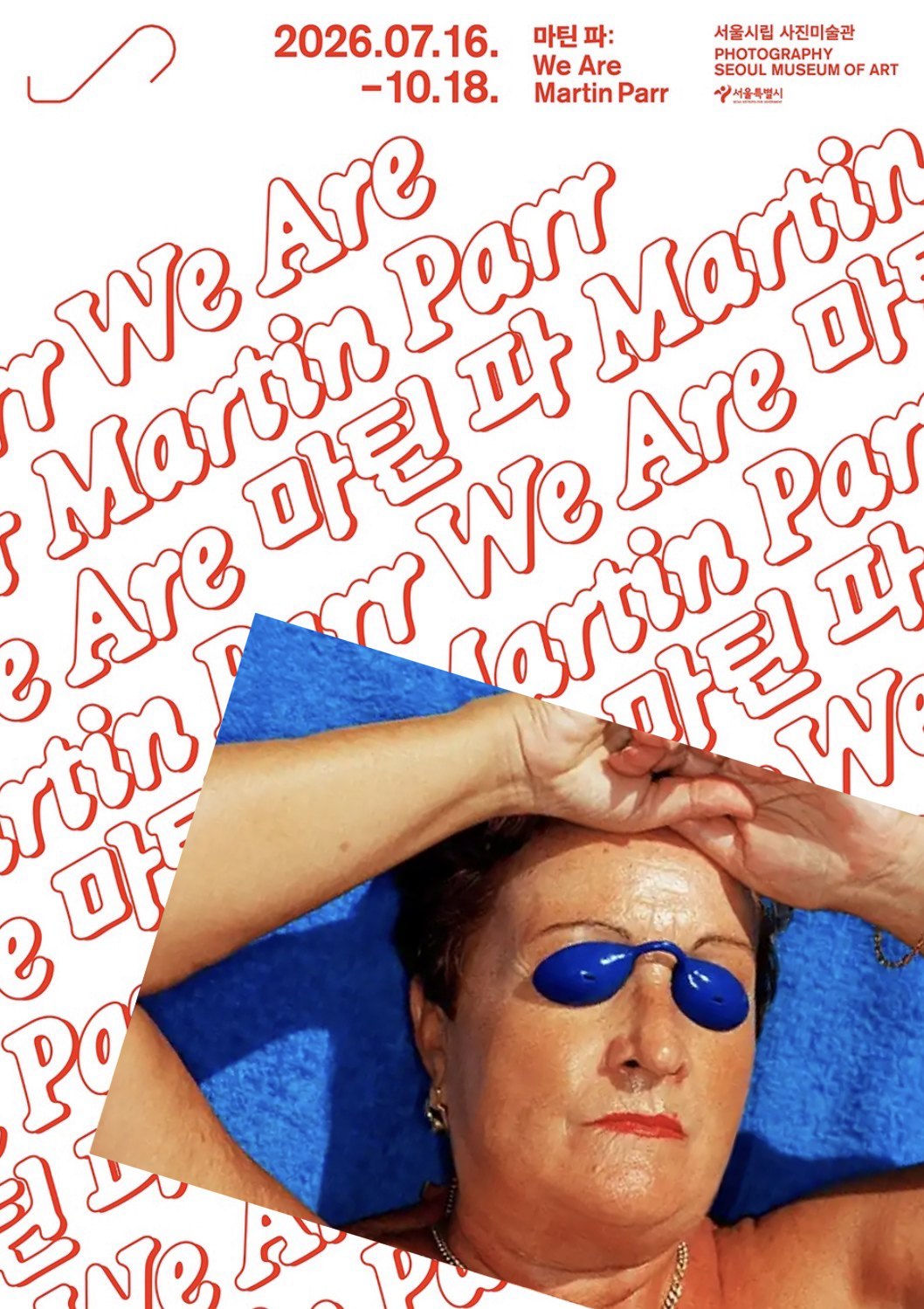
When a photographer dies, the work comes back after a while in the form of a retrospective. For Martin Parr, the wait is less than seven months. In July, seven months after his death, his first major retrospective in Asia opens in Seoul.
The Exhibition in Brief
The title is 〈Martin Parr: We Are Martin Parr〉. The venue is Photography Seoul Museum of Art (SeMA), which opened last year. It runs from July 16 to October 18, 2026. Admission is free.
About 500 works will be on view, from his early black-and-white pictures to the color of his final years. Fourteen key series hang alongside 89 photobooks he made over his lifetime. The show is co-organized with Magnum Photos and the Martin Parr Foundation.
A Retrospective After His Death
Martin Parr died on December 6, 2025, at his home in Bristol, England. He was 73, and had lived with myeloma for a long time. Magnum Photos issued an official tribute right away, and outlet after outlet reported, in the same tone, that a place at Magnum now stood empty.
So this Seoul show is more than a solo exhibition. It carries two kinds of weight: the first major Asian retrospective since his death, and the first comprehensive retrospective to gather his key series in one place. There is the farewell that any retrospective carries, and there is the summing up, the first chance to read Martin Parr's fifty years as a photographer all at once.
The 14 Series on View
The 14 series chosen for the show cut across nearly every period of Parr's career: early work from his black-and-white years, the mid-'80s when color came in for good, the '90s when he joined Magnum, and work from the 2010s on.
- The Last Resort (1983 ~ 86). Color photographs of working-class holidaymakers on the beach at New Brighton, England. The starting point that announced Parr as a new direction in color documentary.
- The Cost of Living (1986 ~ 89). A satirical look at the daily life of the British middle class. A slice of '80s British consumer culture.
- Small World (1987 ~ 94). Tourists striking the same poses for photos at sights around the world. The turning point where Parr's gaze widened from Britain outward.
- Common Sense (1995 ~ 99). Color close-ups of supermarket shelves, processed food and small everyday objects. A close look at the surface of consumer society.
These four are usually named as the core of Parr's work. The show adds ten more series to make fourteen. This is the first time his work has been brought together in Asia at this breadth.
Why 89 Photobooks Are on Display
Martin Parr made photobooks as much as he made photographs. He never stopped binding his own work into books, and he put the same weight into collecting, cataloging and assessing other photographers' books. The photobook collection and guides that bear his name have been treated as something of a benchmark in the field.
That is why 89 of his photobooks are part of this retrospective. For Parr, the book was never a byproduct of the work. It stood on the same level as the work itself. Seeing prints on the wall and books on the shelf as two faces of one artist is one of the threads running through this show.
Martin Parr's Two Koreas, Early 2000s
For Korean viewers, one part of the show is especially new. Photographs the artist took in South and North Korea in the early 2000s are being shown for the first time.
Until now, almost no primary material was known about how Parr saw Korea or what he pointed his camera at. Will the tone differ from what other Magnum photographers left on the peninsula, or match it? How did the gaze he turned on British and European tourist spots play out in Korea? This exhibition offers the most direct answer to those questions.
The Venue: Photography Seoul Museum of Art
Photography Seoul Museum of Art, where the show takes place, is the photography branch of the Seoul Museum of Art that opened last year. It took Korea a long time to get a public museum devoted to photography, and this branch was built to fill that overdue gap.
Choosing Martin Parr for its first major retrospective of a foreign artist, in its first year, is worth reading as a signal of where the museum is headed. Its first guest is a photographer who sits squarely in the color documentary tradition.
How to Look at Martin Parr
To someone seeing his work for the first time, Parr often comes across as a strange photographer. The colors are too loud, the people aren't especially graceful, and some scenes almost seem to mock. Sunbathers on an English beach, a close-up of a fast-food tray, a tour group holding selfie sticks in identical poses. Somehow familiar, somehow uncomfortable.
That was his consistent method. He turned his camera on the society he lived in, but instead of satirizing it from a distance, he went inside and shot up close. So his pictures don't hate tourists. They share the embarrassment as one tourist among many. They don't condemn consumer society. They show its surface honestly, as one consumer among many. A different kind of documentary from the kind that keeps its distance, and he pushed it consistently for fifty years.
This retrospective is a good chance to follow that thread from start to finish.
At a Glance
- Title 〈Martin Parr: We Are Martin Parr〉
- Dates July 16 (Thu) – October 18 (Sun), 2026
- Venue Photography Seoul Museum of Art (SeMA)
- Admission Free
- Scale About 500 works, 14 series, 89 photobooks
- Key series The Last Resort, The Cost of Living, Small World, Common Sense and 10 others
- First shown in Korea Photographs of South and North Korea from the early 2000s
- Co-organizers Magnum Photos, Martin Parr Foundation
- Significance First major Asian retrospective since the artist's death (died 2025.12.6), and the first comprehensive retrospective in Asia
Sources: official press release from Photography Seoul Museum of Art (sema.seoul.go.kr), Magnum Photos · Martin Parr Foundation, Magnum tribute (2025.12), obituaries in Al Jazeera, Wallpaper* and others, W Korea 2026 culture calendar. The final list of works and related events (docent tours, talks, public programs and so on) is expected to be announced on the museum's official website before the July opening. Poster image © Photography Seoul Museum of Art.