

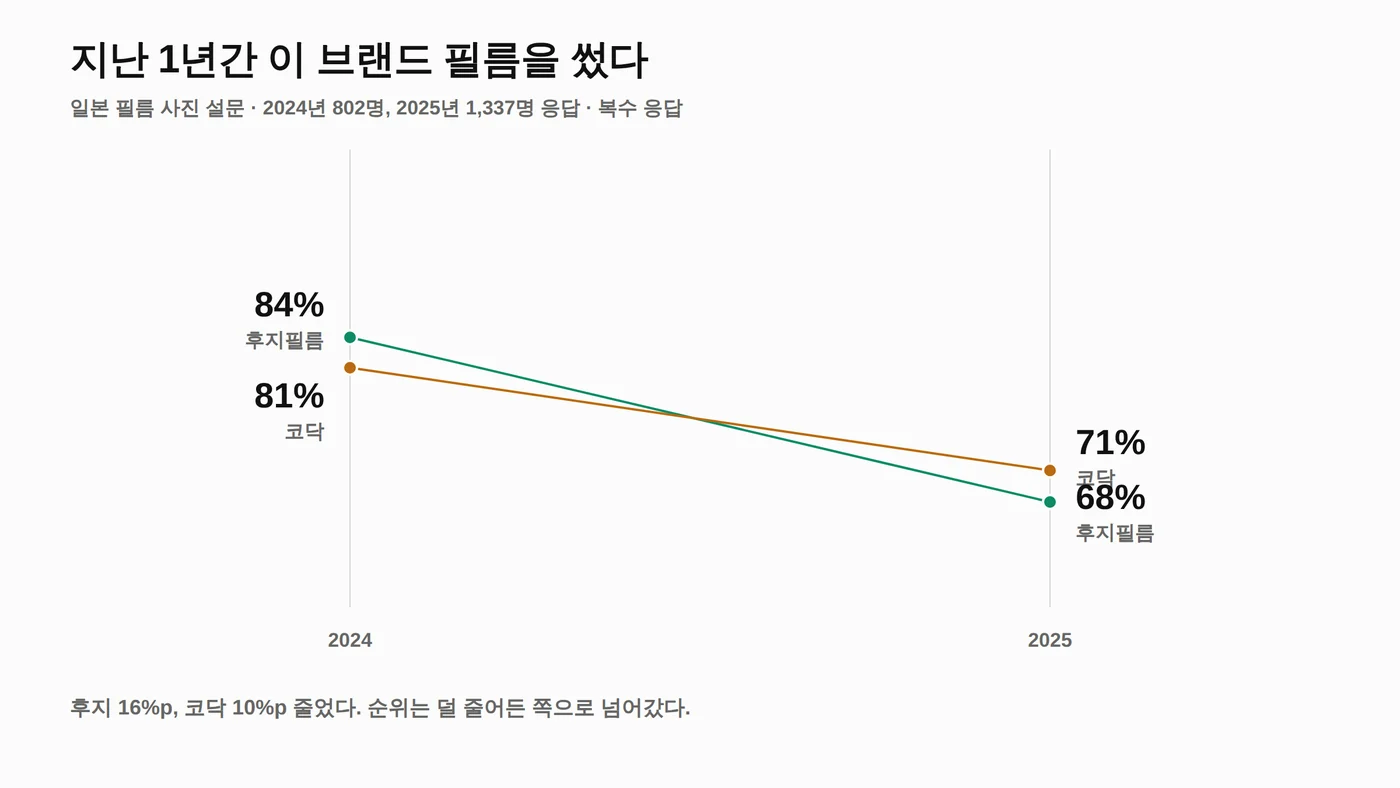
FilmFocus, a Japanese film photography site, has published the results of its second survey. 1,337 people responded, up 67% from 802 the year before. The line that spread widely from it is this one: Kodak passed Fuji.
That's true. But read only that line and you come away with the opposite picture.
The ranking changed, and both fell
Asked whether they had used a brand's film in the past year, 71% said yes for Kodak and 68% for Fuji. The year before, it was Fuji 84% and Kodak 81%.
Fuji dropped 16 percentage points and Kodak 10. Kodak simply lost less. The two lines crossing in the middle of the chart at the top are what this survey actually shows.
The larger pool of respondents is mixed into this too. When the sample grows from 802 to 1,337, the tastes of the newcomers shake the percentages. These are not the same people surveyed twice.
Yet the amount people shoot is the same
While the brand percentages shifted, consumption barely moved.
| Category | 2024 | 2025 |
|---|---|---|
| Annual average, 35mm users | 13.7 rolls | 13.9 rolls |
| Annual average, 120 users | 6.9 rolls | 7.0 rolls |
Fourteen rolls a year. A little more than one a month. That number has stayed put two years running.
Of those who said they were shooting less, 62% cited price as the reason. And yet the overall average didn't drop. Who filled the gap?
Who cut back, and who came in
The survey broke the question down by experience. The answers split very cleanly.

Among those with less than a year of experience, nearly half said they shot more. Only 6% said they cut back. People who have been shooting for more than 10 years are the reverse: 40% said they cut back, and 15% said they shot more.
Go down the bands and the blue segment shrinks from 49 to 40, 31, 21 and 15, while the red one grows from 6 to 11, 26, 32 and 40. Not one band breaks the pattern.
The survey also shows how people respond to prices. They narrow down to a few films they use often, pick up cheaper stocks, and some develop at home. The longer someone has been shooting, the sooner they make these adjustments.
So the average held not because the market is healthy. Newcomers filled the space left by people who had been shooting for years. Inside the same number, the people are changing.
How people choose a lab
The survey also asked about what happens after shooting: what matters most when choosing a lab?
| Lab selection criterion | Share ranking it first | Average rank |
|---|---|---|
| Development and scan quality | 41% | 2.2 |
| Price | 24% | 2.6 |
| Distance and location | 20% | 3.6 |
| Turnaround time | 8% | 3.6 |
| Range of services | 4% | 4.2 |
| Word of mouth and friends' reviews | 3% | 4.8 |
Quality leads price by nearly two to one. People who say film is expensive still don't go to the cheapest lab. They believe the choice of where to send film decides the result more than the choice of film itself.
So what about Korea? We tallied the 92 labs listed in our catalog as they stand.
| 35mm color | Labs listing a price | Median | Lowest | Highest |
|---|---|---|---|---|
| Standard development + scan | 88 | 6,000 won | 3,000 won | 20,000 won |
| High-resolution scan | 31 | 9,000 won | 6,000 won | 18,000 won |
For standard development, the most expensive lab charges more than six times the cheapest. Only 31 labs offer a separate high-resolution scan.
What stands out is something else. Of the 92 labs, only 39 state their scan resolution. That's less than half. People are told to choose on quality, yet they hand over their film without knowing what they will get back.
How we counted
- We collected the published price lists of the 92 labs in the 5ft.mag lab catalog as they are
- Labs that don't publish a price were left out, so the number counted differs by item
- These are medians, not averages, so that one or two high prices don't pull up the whole
- Prices change. Please check the labs page for current figures (Korean only)
The next numbers are ours to make
What we envy about the Japanese survey is not the Kodak and Fuji ranking. It is that two years of data have piled up, so it can talk about change.
We have the price lists of 92 labs. What we don't know yet is how many rolls our readers shoot in a year, or what they look at when choosing a lab. For that, we have to ask.