"Film got through the years when it was disappearing, and now it is being made again. One strand of that movement is happening in China."
In the spring of 2012, China's Lucky Group Corporation stopped producing color negative film. The factory in Baoding, Hebei, which had once worked with Kodak to refine its formulas, shut down its color conveyor and kept only the black-and-white line. Digital had taken the market. Thirteen years have passed since. And the cans are rolling again.
The rumor that had been going around since last year, that "Lucky is making color again," took solid shape in the spring of 2025. The first pre-production film arrived in June, a box or two at a time, starting with small camera shops in Guangdong, and the official launch came at a trade fair in Shanghai in July. The name is simple: Lucky Color 200. ISO 200, C-41, in both 35mm 36-exposure and 120. What matters most is the formula. This time it is Lucky's own, developed without an outside partner.
Color comes back: Lucky Color 200
The first impression reviewers keep pointing to is "neutral, but slightly warm." It is not as heavy on yellow as Kodak Gold 200, and its cyans are not as lively as Fujicolor 200. A faint red cast sits just at the edge of visibility, and the grain is surprisingly fine compared with other films around ISO 200. The tone is said to be intentional. According to the explanation that comes with it, Lucky tried to bring back "the taste of the old Lucky color" when it built its own formula.
Distribution is still narrow, though. The first release went only through selected retailers inside China, and small amounts are trickling abroad through Reflx Lab, a respooling brand based in Shenzhen (深圳). Prices have not settled either and jump around. Korea has no official importer yet, so it comes in a box or two at a time, by way of Japan or Hong Kong or direct orders on Taobao.


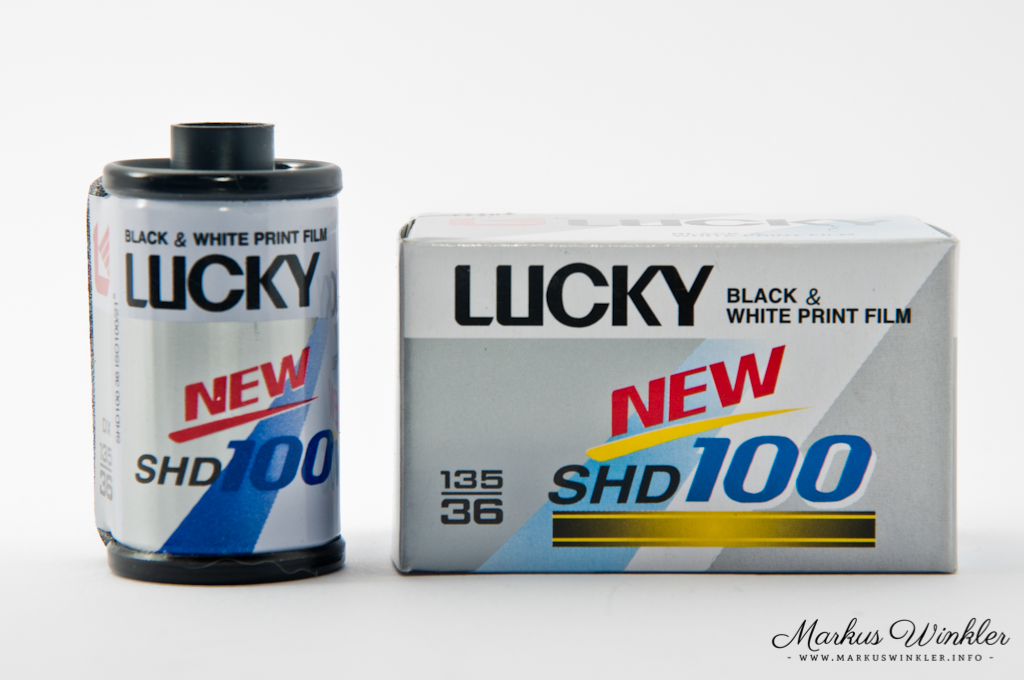
Lucky's color revival did not come out of nowhere. Black-and-white paved the way first. SHD 100 returned in a New version in 2017, and in March 2024 SHD 400 went back out to the global market. SHD 400 was originally produced in the early 2000s in cooperation with Kodak, then discontinued along with the color films in 2012, which makes this a comeback after about twelve years. Its signature look, a faint glow around the highlights thanks to a thin antihalation layer, is still intact.


The black-and-white that never stopped: Shanghai GP3
While Lucky went through a full cycle of discontinuation and revival, another black-and-white line kept running with barely a break: Shanghai GP3 100. First made in 1958 at the Shenbei photosensitive materials factory in Shanghai, it is an entry-level black-and-white film that has supplied the Chinese domestic market ever since.
It stayed little known for a long time. Then in the early 2000s, the internet and a few resellers in Hong Kong started sending it out through eBay, and it became a cult film among enthusiasts abroad. The original formula was discontinued once in 2016, but the name was soon taken over by Shanghai Jiancheng Photography, which relaunched it in 2019 with a new formula on a new film base. Same name, different film.
A roll costs around US$3.50 for 35mm, 36 exposures, making it one of the cheapest panchromatic black-and-white films on the market. Fine, calm grain at ISO 100, steady tones, forgiving latitude. It is not flashy, but it is easy to work with. For students, beginners or anyone looking for a roll to use casually, it is one that keeps coming into the Korean market too.
Cinema film, the Chinese way: Reflx Lab
While Lucky makes color again with its own formula, another Chinese brand is taking a different road: Reflx Lab, based in Shenzhen (深圳). It does not manufacture film itself. It takes Kodak's Vision3 motion picture stocks, cuts them down for 35mm still photography and packs them back into cans. This is what is known as respooling.
It has three main lines. Reflx Lab 800 (formerly 800T) is based on Vision3 500T, with the remjet layer used for cinema removed so it can go through standard C-41 processing. Reflx Lab 500T is the same Vision3 500T but keeps the remjet layer, the purist route that sticks to the original ECN-2 cinema process. Reflx Lab 250D offers a daylight-balanced cinema look. What is interesting is that two companies on opposite sides of the world are running a similar pattern in parallel: Cinestill in Los Angeles, and Reflx Lab in Shenzhen.
The two clashed once, in a 2023 trademark dispute over 800T. It began when Cinestill claimed rights to "800T" itself, and in the end Reflx Lab dropped the "800T" name and switched to just "800." It was the first serious trademark fight in a film hobby market that had grown small and fast.
Film is not being made again in just one way. There is the road of writing new formulas, the road of keeping old formulas alive, and the road of carrying cinema film over to still cameras. The roads split, but the current runs in one line.
In the end, a will not to disappear
In the early 2010s, the darkest years of the film market, quite a few lines vanished: Fuji Pro 400H, some Kodak Ektachrome stocks, and Lucky's color films. In the same years, digital got better at just about everything. So everyone expected film to end up as a nostalgic memory.
Then in the 2020s, things quietly shifted. Ektachrome E100 came back, new film cameras like the Pentax 17 were built, Lucky rebuilt its color, Shanghai kept its black-and-white line going, and Reflx Lab and Cinestill brought cinema film home. Different methods, pointing to the same conclusion. Film is not going away. It gets made again, kept going, or cut down and packed back into cans.
That is why 5ft magazine added Lucky Color 200 and Lucky SHD 100/400 to our library together this time. Stories that belong on the same line of a single catalog are coming together. The next time you pick a roll, maybe it will be a can with red lettering on it.