"Strapping a twin-lens reflex to your wrist sounds like a joke. Look at the sketch, though, and it isn't one."
On September 2, Artra posted the CAMERA DUAL ROLLEIFLEX to its Instagram. It is a wristwatch modeled on the Rolleiflex twin-lens reflex camera. At first there was only a single pencil design sketch. Since then, the real thing has gone on display.
The company has said three things: it is limited to 100 pieces, price and release will be announced at the end of October, and it is licensed from RCP Technik Verwaltungs-GmbH of Germany, which holds the Rollei trademark. The license was brokered by Forkids (HK) Promotion in Hong Kong.
What the real thing looks like
The watch magazine Quill & Pad reported on the production pieces, with photos, from a watch fair held in Hong Kong on September 12. The two pieces on display pair a stainless steel case with a black dial. There are two straps, white leather and black leather. Two large dials sit one above the other, with four small subdials arranged around them on all four sides. The ROLLEIFLEX nameplate at the top is exactly as it appeared in the sketch.
A round mirror stood at an angle in front of the display, so visitors could see the caseback too. Behind stood two real Rolleiflexes, and the watch's two dials and the cameras' two lenses faced each other at the same height.
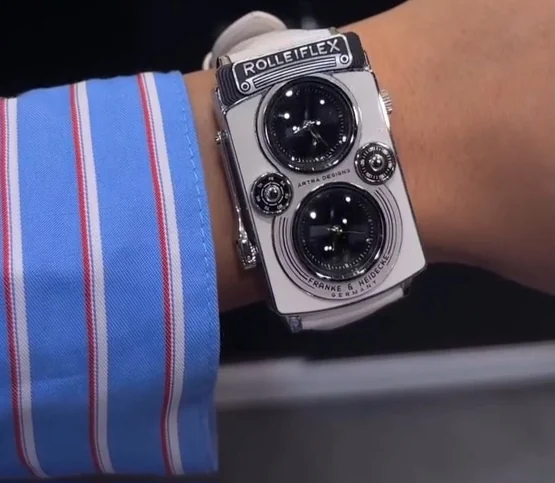
On the wrist, size is the first thing you notice. The case covers almost the full width of the wrist. The sides are cut with fine vertical grooves, carried over from the side finish of an actual Rolleiflex. A crown and a small lever stick out on the left.
What it borrows
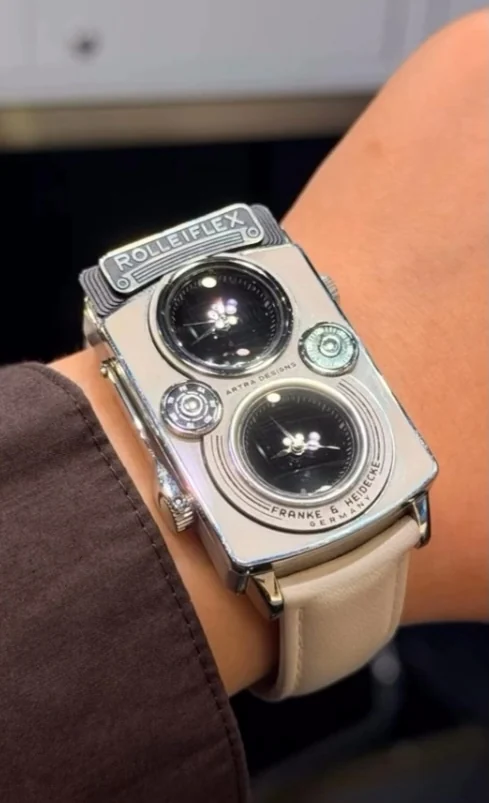
In the sketch, the two dials catch your eye first. Two large circles sit one above the other, following the layout of a Rolleiflex's taking lens and viewing lens. The company wrote that "every rotating disc and engraved badge is a tribute to the mechanical romance of film photography."
The details go further. A ROLLEIFLEX nameplate sits at the left corner of the case, in the same place as the front badge on the camera. Around the lower dial runs the engraving FRANKE & HEIDECKE GERMANY, the name of the company that made the Rolleiflex. On the camera, the same words circle the viewing lens. On the narrow strip between the two dials, ARTRA DESIGNS is written vertically.
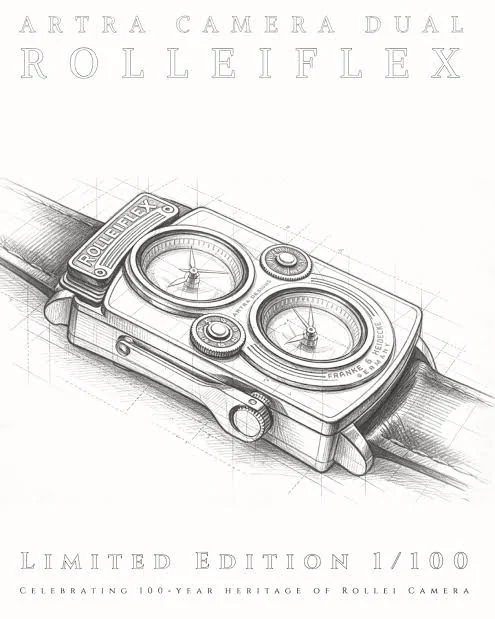
Faint dimension lines and construction lines run behind the sketch. Instead of a product shot, the watch was first introduced as a technical drawing.
Who Artra is
Artra Lab started in Hong Kong in 2018. It was founded by a group of photographers, architects and product designers, and has made lenses and photo accessories since then. Manual lenses that revive old designs, like the Similar 35mm f/1.4, are its line of work. Watches got their own label in 2025, ARTRA DESIGNS. The brand's motto is Art, Random Adventure.
Before this, the Camera One
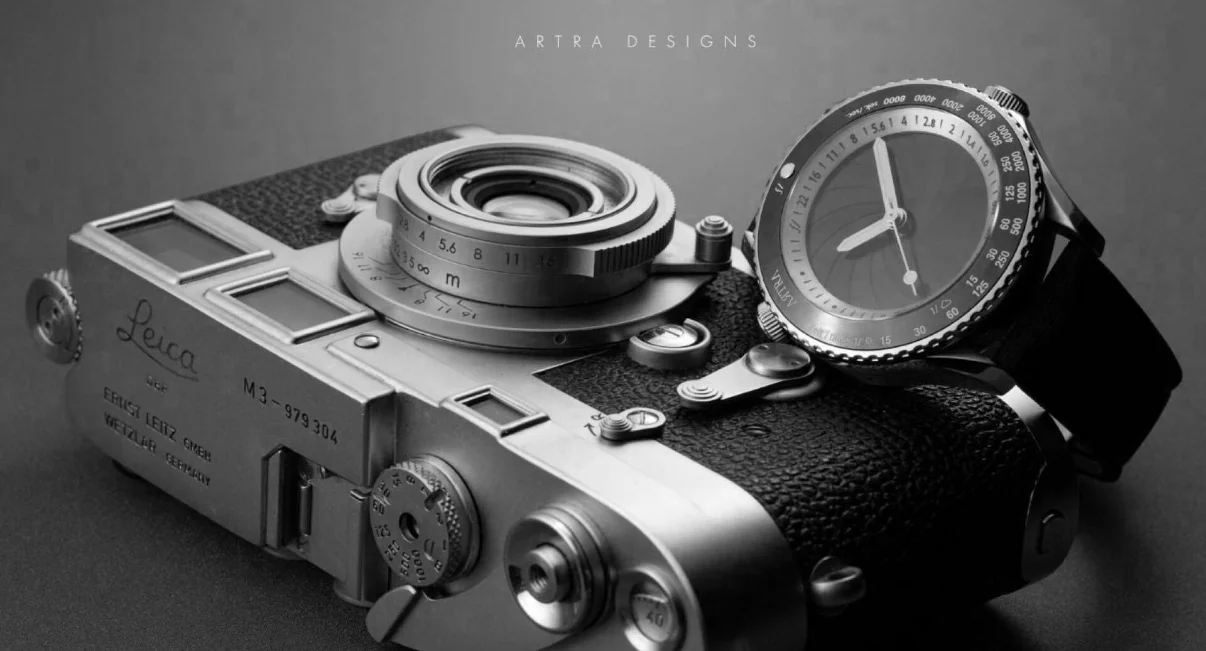
The Camera One gives you a sense of where the Rolleiflex watch came from. On that watch the dial itself is a lens aperture. Turn the crown at upper left and the aperture blades open and close. It is easy to mistake for a shutter, but what moves is the aperture.
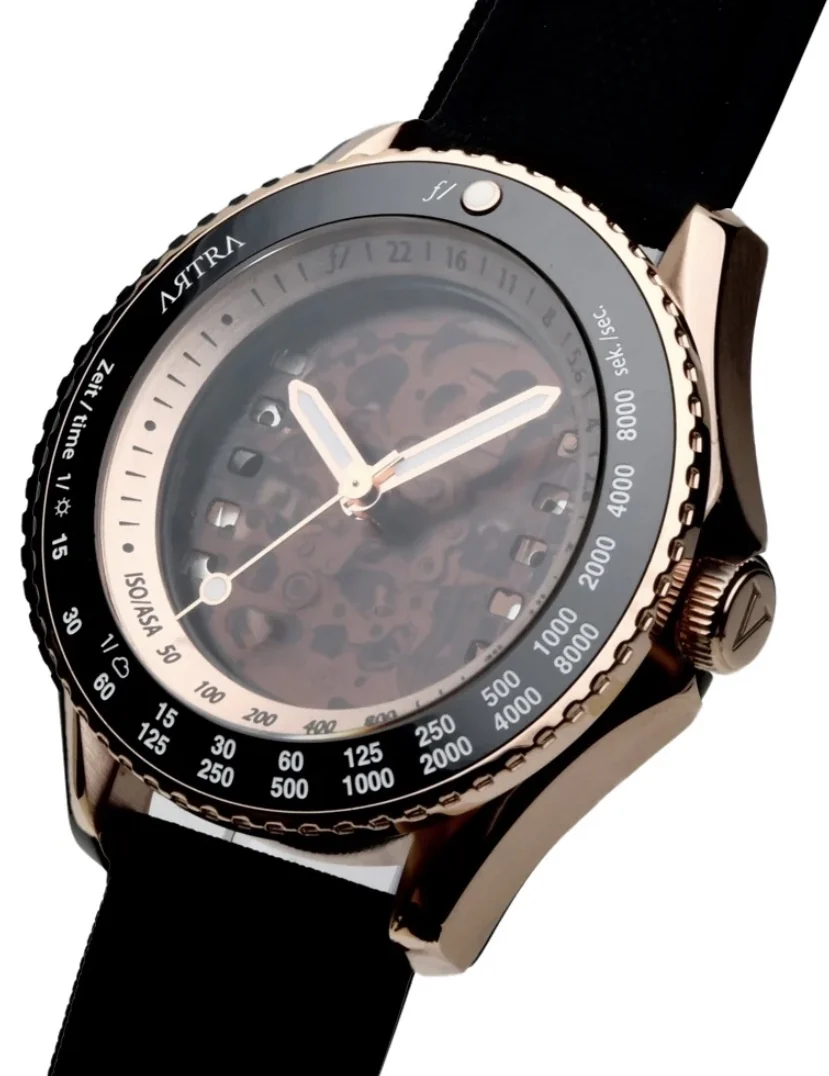
Open it all the way and the movement inside is on full view. Close it all the way and the blades overlap in a swirl until the whole face goes dark. It is the same sequence as stopping down a lens and watching the back go black.
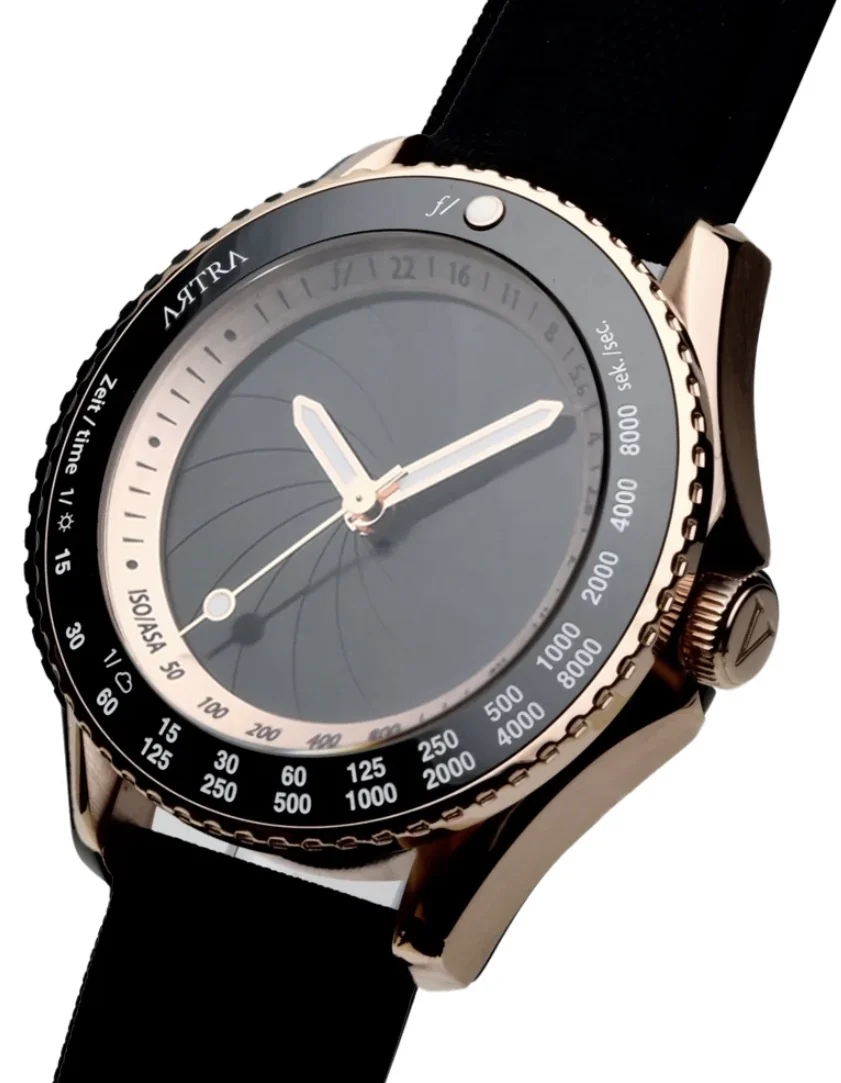
The bezel carries the Sunny 16 rule. You turn the outer ring to match ISO, aperture and shutter speed against one another. That does not mean there is a light meter inside. It is closer to a paper exposure chart moved onto your wrist.
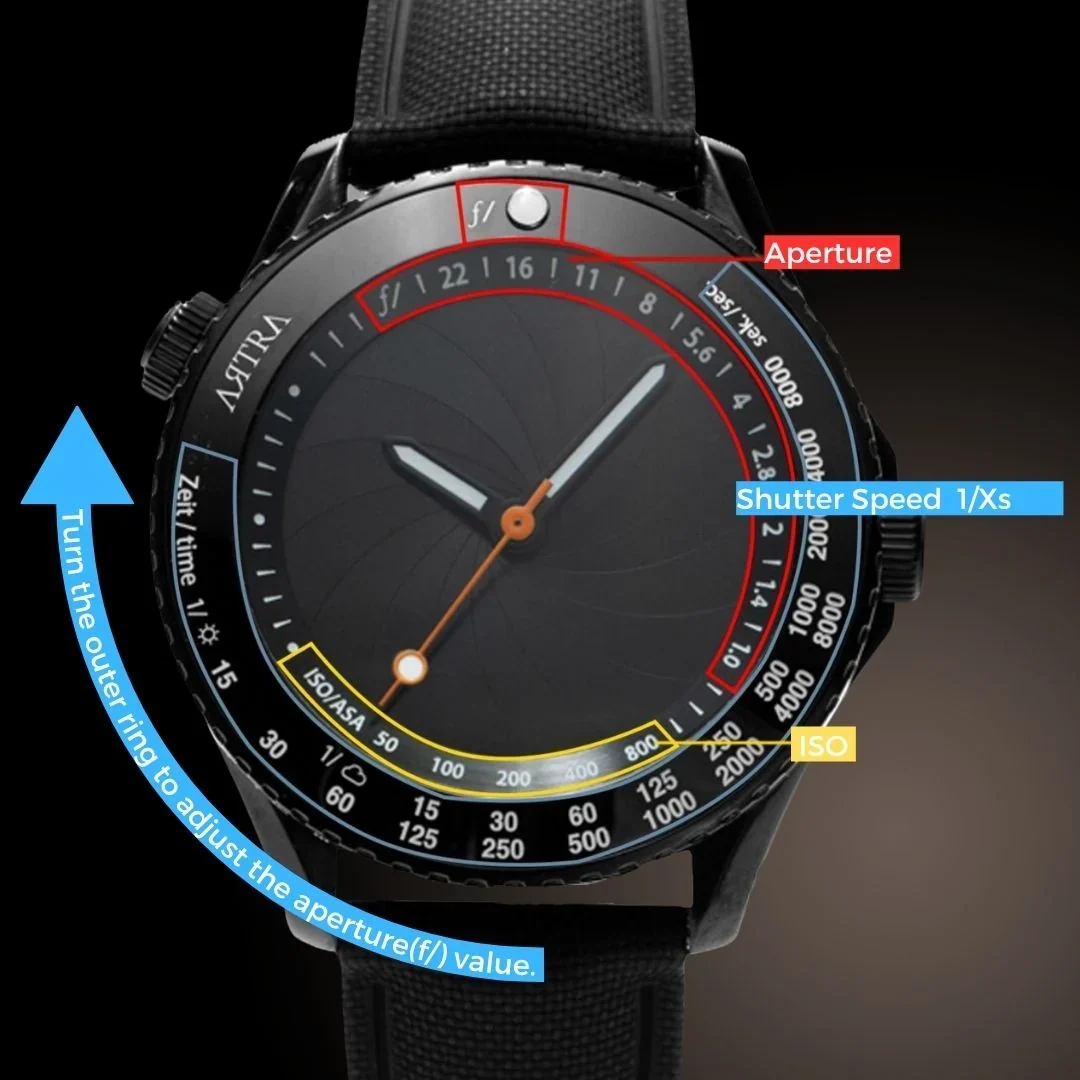
Here is how the scales break down. The inner ring runs apertures from f/1.0 to f/22. Outside that, shutter speeds run from around 1 second to 1/8000. At the bottom, ISO runs from 50 to 800. An ƒ/ mark and a white dot at 12 o'clock serve as the index, and there are sun and cloud symbols too. It is the old Sunny 16 arithmetic: set it here when it's sunny, there when it's overcast.
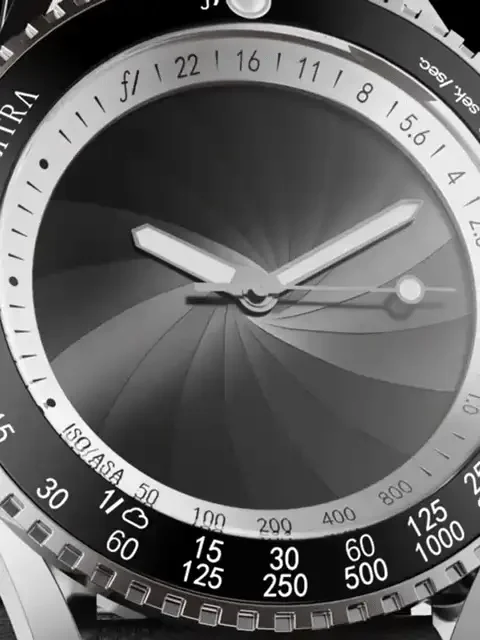
The scale also prints the German Zeit alongside the English time. A depth-of-field scale is engraved on the side of the case.
The back is the fun part. The rotor is engraved with Eadweard Muybridge's 「Horse in Motion」, the 1878 sequence of a galloping horse that proved there is a moment when all four hooves leave the ground. The moment photography began slicing up time now sits on the watch's rotor.
Among the illustrations released with it is one explaining film formats. It is about where the 35mm we use today came from.
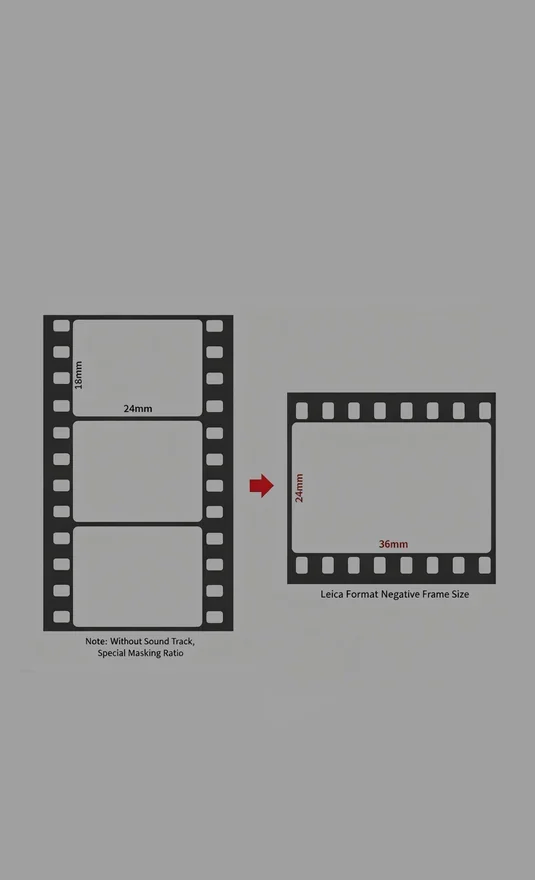
Cine 35mm film ran vertically and held 24 × 18mm per frame. Oskar Barnack built a camera that ran the same film sideways, and each frame doubled to 36 × 24mm. Leica introduced that camera at the 1925 Leipzig Spring Fair and sold a thousand in the first year. Kodak later gave the format the number 135, the number you see every time you pick up a roll of film.
The Rolleiflex model continues that line with one difference: it officially carries the Rollei trademark. Where the Camera One was a metaphor for cameras in general, this one uses the name and badge of a specific camera.
The Camera One comes in five versions
The official product page lists five versions. They differ in case finish and quantity.
- SLV Silver. 999 pieces
- DLC Black Diamond-like carbon coating. 500 pieces
- RG Rose gold color. 99 pieces
- DLC Black Steel Special Edition Made with THE LAVISH ATTIC. 10 pieces
- Steel DLC Black Special Edition Another combination from the same collaboration. 10 pieces
Quantities are as listed on the product page. Prices and availability vary by country and by date, so we have left them out.
The site also has a line called WRIST POP, but those are not watches. They are cases and straps that let you wear a separately sold pocket watch on your wrist.
About that "100 years"
The introduction opens with a line about celebrating "the 100-year legacy of the Rolleiflex twin-lens reflex camera." The number deserves a second look.
Paul Franke and Reinhold Heidecke founded their company in Braunschweig in 1920. Rolleiflex production began in 1928, and sales started in 1929. Before the first year was out, there was a backlog of 8,000 orders. So as of 2026 the company is 106 years old and the camera is 97. The number 100 fits neither exactly.
Nobody needs to take the figure in a commemorative line literally. But if the timeline is being used to sell a 1929 camera turned into a 2026 watch, we thought readers were better off knowing the actual dates.
What we don't know yet
The watch is out, but the specs are not. Case diameter and thickness have not been released. What does each dial show? From the photos alone, you can't tell how the two large circles and four small ones split timekeeping and complications between them. Nor has it been confirmed whether aperture blades move, as on the Camera One.
As for the movement, talk in watch communities has it as a Miyota automatic with a custom module that turns two discs. The company has not confirmed this, so we note it here only as something people are saying. There is no official product page yet either.
The edition of 100 is worth a thought too. TACS got there first with a Rollei-branded watch, the ATL Rollei, in an edition of 500. This one is a fifth of that. Where the price lands will be known at the end of October.
The camera you once held at waist level and bowed your head to look into has moved up to the wrist. All that's gone is the angle of looking down into it.
At a glance
- Product ARTRA CAMERA DUAL ROLLEIFLEX. A wristwatch modeled on the Rolleiflex twin-lens reflex camera
- Edition Limited to 100 pieces
- Price and release To be announced at the end of October 2026
- Rights © 2026 RCP Technik Verwaltungs-GmbH. Licensed through Forkids (HK) Promotion Co., Ltd.
- Unveiled September 2, 2026, on Artra's Instagram (@artralab)
- Production pieces Stainless steel case with a black dial. Two straps, white leather and black leather
- Maker ARTRA LAB (Hong Kong, 2018). Has made lenses and photo accessories, and started watches as ARTRA DESIGNS in 2025
- Earlier watch Camera One in five versions. SLV 999 pieces · DLC Black 500 · RG 99 · two THE LAVISH ATTIC collaborations of 10 each. Aperture blades open and close; the bezel carries scales for aperture f/1.0 to f/22, shutter around 1 second to 1/8000 and ISO 50 to 800; Muybridge's horse is on the rotor at the back. The concept materials also cover the origin of the 35mm format
- Unconfirmed Case dimensions, movement specs, what the two dials do, distribution in Korea, official product page
This article is based on ARTRA's posts, its official product materials and photos from the exhibition floor. Throughout, we have separated what the company stated from what has come from watch media and communities. Detailed specs and whether it will be sold in Korea are not yet confirmed. We will update this article after the end-of-October announcement.