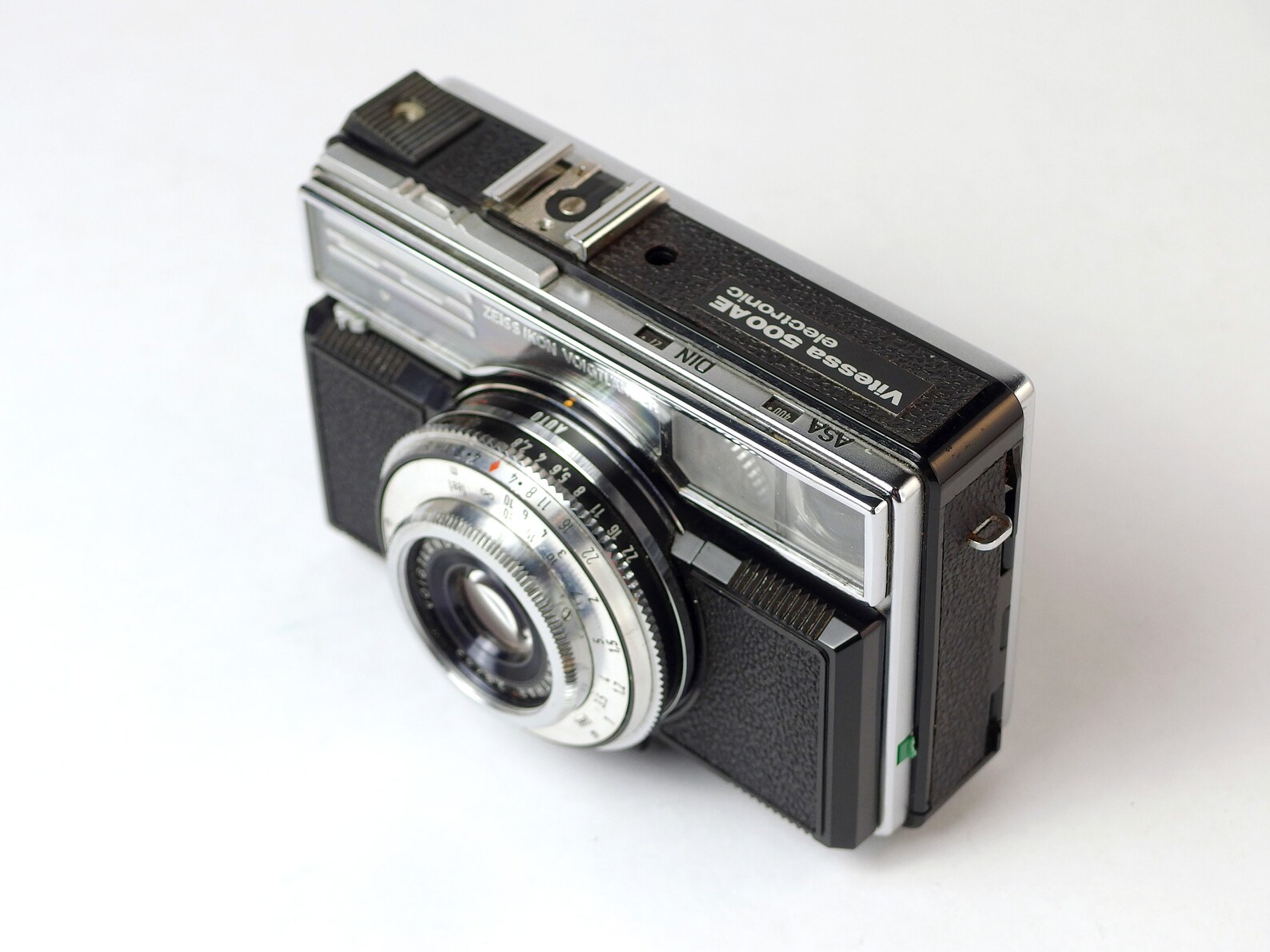
"Excuse me, is this a radio?"
That is the question customers ask most often, eyes full of curiosity, in front of the display case at Ally Cameras. A neat rectangular design, a big dial filling the front, and a red button on top. It looks for all the world like a 1960s portable radio or a cassette tape, but this camera is in fact the Voigtländer Vitessa 500.
If the classic Vitessa of the previous generation stood for elegance, this one was born wearing 1960s modernity and a playful pop sensibility. It is a different kind of charmer altogether.
A boxy design ahead of its time

What grabs your eye first is the unusual design, well ahead of its time. It rejects the typical camera silhouette with a lens sticking out and opts for a 'box design' that tucks everything neatly inside the body.
The shutter button is especially fun. Instead of the usual small round button, a wide, long rectangular shutter sits flush with the body on one side of the top plate. With nothing sticking out, the camera looks even more like a square box, and you press it lightly with your whole finger, which gives it a feel all its own.
The film speed (ISO) dial is also placed large on the front of the body rather than on the lens. Turning it, you really do get that analog feeling at your fingertips, like tuning a radio frequency or adjusting the volume.
Color-Lanthar and scale focus

It is not just a pretty design. At its center sits Voigtländer's proud, practical lens, the Color-Lanthar 42mm F2.8.
Focusing is the classic scale focus type, where you estimate the distance to your subject by eye. If the subject looks about 3 meters away from where you stand, set the lens to '3' and press the shutter. It may feel unfamiliar at first, but once you get used to it, you can set the distance quickly without looking through the viewfinder and fire off snapshots, which is the real pleasure of this kind of shooting.
Thanks to the comfortable 42mm angle of view and the fast lens, it produces quite fine, vintage-looking results even on cloudy days or indoors.
Two giants, one camera
Look closely at the camera and you will find some hidden history. Interestingly, it carries the logos of both Zeiss Ikon and Voigtländer, the two great pillars of German camera making.
This small camera is evidence of a turbulent time in the 1960s, when Voigtländer, pushed back by the onslaught of Japanese cameras, merged with its rival, the Zeiss Ikon group. The company may have changed hands, but Voigtländer's engineers passed the name of their former top-end model, the Vitessa, on to this compact, planting one last bit of pride in it: "Small and affordable, but we will keep the performance and the name."
Everyday life on the Vitessa: sample shots
Below are two scenes that Kang Hye-won, CEO of Ally Cameras, took in Paris with the Vitessa. The vintage density, the warm color and the relaxed pace that comes with a scale-focus camera all come through.


Tune in to everyday life
It is also a charming fashion item. Head out with a Vitessa around your neck and you are sure to hear "What's that pretty camera?" at least once.
If you are looking for a German vintage camera that stands apart, this little radio camera will tune your everyday life to a special frequency.
Meet a real Vitessa
You can try one in person at Ally Cameras, and 5ft magazine Vol.02 has more camera stories and work shot on CineStill 800T.